The so-called discovery of the Americas in 1492, long celebrated as one of the “cultural achievements of the Renaissance,” was simultaneously a profoundly violent geopolitical event. While it offered European powers new opportunities for expansion, resource extraction, and economic accumulation, it also destabilised the intellectual and theological foundations on which Europe had built its vision of the world.
The encounter with Indigenous peoples—whose existence had not been accounted for within biblical genealogies—introduced an unexpected philosophical and political crisis. In the Christian worldview of the time, the earth was populated exclusively by the descendants of Noah’s three sons: Shem in Asia, Japheth in Europe, and Ham in Africa. The presence of the so-called “Indians” contradicted this narrative and threatened the authority of religious doctrine, which underpinned not only spiritual belief but also legal and moral systems.
To resolve this tension, Europe engaged in a systematic project of ideological adjustment. The history that required preservation—a history that legitimised conquest and domination—also required manipulation. The existence of Indigenous peoples had to be explained away, reclassified, or erased to maintain the coherence of a worldview that justified colonisation as both destiny and divine mandate. This epistemic violence would later become the foundation of racial classification, territorial dispossession, and the institutional architectures of colonial power.
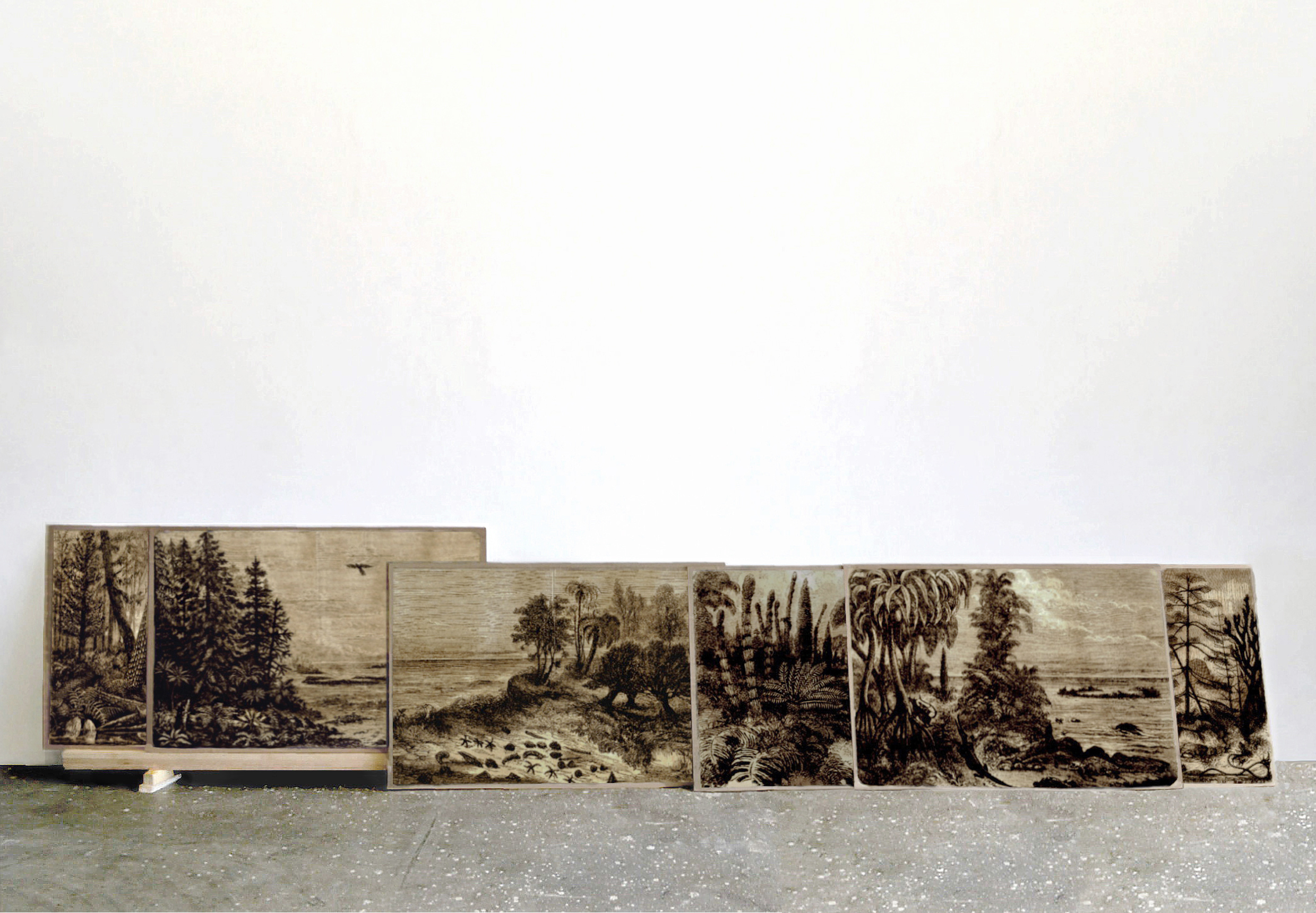
The images in this installation (circa 1800), originally meant to illustrate the world before the biblical flood, participate in that same process of erasure. By manipulating them to remove any human presence, the installation echoes and exposes the historical effort to rewrite the past—an attempt to create a world in which inconvenient lives simply did not exist. The absence becomes a political statement: a reminder of how representation has been used as a tool of authority, and how entire peoples could be visually, conceptually, and historically eliminated in order to preserve the dominant narrative.
This project was conceived as a site-specific context, created specifically for an exhibition in Mexico, where the legacies of these historical erasures remain deeply embedded in cultural memory and political reality.
 annalisafurnari.com